
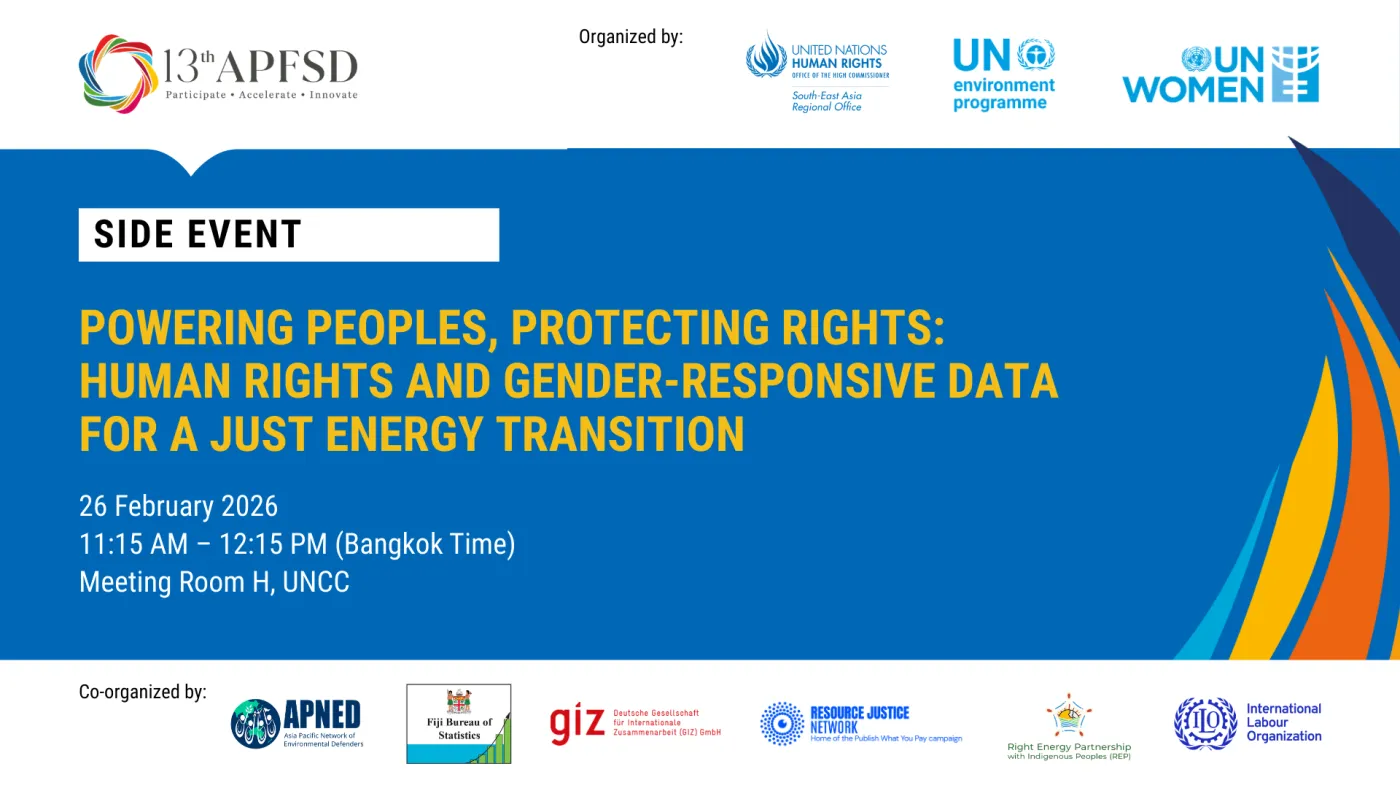
Powering Peoples, Protecting Rights: Human Rights and Gender-Responsive Data for a Just Energy Transition
for online participation
Date & Time:
Thursday, 26 February 2026 | 11:15–12:15
Organizers:
OHCHR, UNEP, UN Women (EmPower)
Co-organizers:
GIZ, Fiji Bureau of Statistics (FBoS), UN Women, International Labour Organization (ILO),
Asia Pacific Network of Environmental Defenders (APNED),
Right Energy Partnership with Indigenous Peoples (REP),
Resource Justice Network
Focal persons:
Ms. Romchat Wachirarattanakornkul – OHCHR Regional Office for South-East Asia
Ms. Breshna Belal Khel – UN Women
Ms. Alexandra Mutungi – UNEP
Brief description:
As Asia-Pacific countries accelerate energy transitions to meet climate goals and achieve SDGs 6, 7, and 9, it is essential that these efforts are inclusive, equitable, and grounded in human and labour rights. This session will examine the human rights risks associated with renewable energy development and critical mineral extraction—such as land dispossession, water scarcity, labour exploitation, and environmental degradation—particularly affecting Indigenous Peoples, women, vulnerable workers, and rural communities.
Drawing on regional case studies, the discussion will explore governance, accountability, and benefit-sharing mechanisms to prevent harm and avoid extractive models disguised as green development. The session will also highlight the critical role of gender-responsive and disaggregated data (SDG 17.18) in strengthening accountability, informing policy design, and supporting inclusive energy transitions. Practical, VNR-relevant examples from national and regional initiatives will be shared to support Member States in advancing rights-based and people-centred energy policies.
Concept Note
As countries across the Asia-Pacific region accelerate their energy transitions to meet climate commitments and advance the 2030 Agenda, it is critical that these transitions are inclusive, equitable, and grounded in human and labour rights. While renewable energy development and critical mineral extraction are essential for achieving SDGs 6, 7, and 9, they can also create new risks, such as land dispossession, water stress, labour exploitation, and environmental degradation, if not governed responsibly.
This side event will examine the human rights dimensions of the energy transition, with particular attention to the impacts on Indigenous Peoples, women, vulnerable workers, and rural communities. Drawing on regional case studies, the session will explore how governance frameworks, accountability mechanisms, free, prior and informed consent (FPIC), and equitable benefit-sharing can help prevent harm and avoid extractive models being repackaged as “green” development. The discussion will also emphasize the central role of decent work, social dialogue, social protection, and rights at work in achieving a just transition that is truly people-centred.
A key focus of the event will be the role of high-quality, gender-responsive and disaggregated data (SDG 17.18) in strengthening accountability and informing inclusive energy policies. Participants will hear from national, regional, and thematic initiatives—including gender and energy data briefs, regional indicators, and practical tools—that demonstrate how data can reveal who benefits from energy policies, who is left behind, and how policy design and implementation can be improved. The session will offer concrete, VNR-relevant insights for Member States seeking to align energy transitions with human rights obligations and the SDGs under review.
From the Ground Up: Strengthening Indigenous Data, Direct Partnerships with and Financing for Indigenous Peoples

for online participation
Date & Time:
Thursday, 26 February 2026 | 12:45–13:45
Organizer:
Tebtebba (Indigenous Peoples International Centre for Policy Research and Education)
Co-organizers:
Indigenous Navigator Consortium, Indigenous Peoples Major Group for Sustainable Development, OHCHR Regional Offfice for South-East Asia, Asia-Pacific Regional CSO Engagement Mechanism, Right Energy Partnership with Indigenous Peoples
Focal person:
Ms. Romchat Wachirarattanakornkul – OHCHR Regional Office for South-East Asia
Brief description:
This side event will examine how Indigenous Peoples can be meaningfully included in SDG implementation and reporting in Asia-Pacific. It will highlight Indigenous-led monitoring systems, rights-based approaches to VNRs and VLRs, and pathways for direct access to financing, emphasizing partnerships grounded in human rights, accountability, and Indigenous leadership.
Concept note:
Indigenous Peoples across the Asia-Pacific region remain systematically excluded from decision-making, financing mechanisms, and reporting processes related to the 2030 Agenda for Sustainable Development. Despite their vital contributions to climate resilience, biodiversity conservation, and cultural preservation, their voices are often marginalized in Voluntary National Reviews (VNRs) and Voluntary Local Reviews (VLRs) - the very processes meant to track progress on the Sustainable Development Goals (SDGs).
This exclusion undermines the principle of “leaving no one behind.” Indigenous Peoples’ knowledge systems, community-driven monitoring, and localized approaches to sustainability offer unique pathways to achieving the SDGs. Yet, without direct partnerships, direct access to financing, and recognition of their right to self-determination, these contributions remain undervalued and underutilized.
Indigenous Peoples’ community-driven monitoring, data gathering, and analysis, including Community-Based Monitoring and Information Systems (CBMIS), the Indigenous Navigator, and other Indigenous-led initiatives - offer robust, culturally grounded evidence that should be recognized as official data in national and local SDG reporting. Similarly, citizen-generated data provides critical insights into lived realities and must be integrated into SDG monitoring frameworks to complement state-led statistics.
Anchoring VNRs and VLRs in international human rights standards, such as the UN Declaration on the Rights of Indigenous Peoples (UNDRIP) and treaty body recommendations - ensures that states uphold their obligations. Indigenous-led monitoring initiatives, including community-based monitoring and information systems (CBMIS) and the Indigenous Navigator, demonstrate how ethnicity-disaggregated data and Indigenous methodologies can enrich national and local reporting, strengthen accountability, and foster inclusive governance.
This side event directly contributes to SDG 17: Partnerships for the Goals by advancing inclusive, rights-based partnerships and equitable resource mobilization. Target 17.17: Promotes effective collaboration between states and Indigenous Peoples through formalized, direct partnerships. Target 17.3: Advocates for direct access to financing for Indigenous-led initiatives, ensuring resources reach communities at the forefront of sustainable change. Target 17.18: Calls for improved capacity to produce high-quality, timely, and reliable data disaggregated by ethnicity, and recognition of Indigenous-led and citizen-generated data as official sources.
This side event also underscores that achieving the 2030 Agenda requires transformative partnerships built on respect, equity, and recognition of Indigenous Peoples’ rights. By centering Indigenous-led data initiatives, citizen-generated data, direct financing, and self-determination in VNRs, states and stakeholders can move from rhetoric to action, ensuring that Indigenous Peoples are not only included but are leading the way in building sustainable, resilient futures.
Celebrating and advancing the power and leadership of Indigenous Women for transformative, equitable, innovative and coordinated actions for achieving the priority goals of the 2030 Agenda

Date & Time:
Friday, 27 February 2026 | 09:00–10:00
Mode:
In-person
Venue:
MRH (76), UN ESCAP Building
Organizer:
Asia Indigenous Peoples Pact (AIPP)
Co-organizers:
OHCHR Regional Office for South-East Asia (Bangkok)
Indigenous Knowledge and Peoples of Asia
Indigenous Peoples Human Rights Defenders (IPHRD)
Land Territories and Resource Platform
Asia Indigenous Youths Platform
Focal persons:
Mr. Prem Singh Tharu – AIPP
Ms. Romchat Wachirarattanakornkul – OHCHR Regional Office for South-East Asia
Brief description:
This side event will highlight the leadership, knowledge systems, and governance practices of Indigenous Women in the protection and management of water resources. It will explore how Indigenous Women’s stewardship of water ecosystems contributes directly to SDGs 6, 7, 9, 11, and 17, while addressing climate change, biodiversity loss, and pollution. The event will also examine the challenges and threats faced by Indigenous Women and underscore the importance of partnerships with Indigenous Peoples to achieve the SDGs in a transformative and rights-based manner.
Concept Note
Indigenous Women have long played a central role in the protection, management, and governance of water resources through their Indigenous Knowledge Systems, cultural practices, and community-based leadership. Their deep spiritual, cultural, and livelihood connections to water have sustained ecosystems, protected biodiversity, and ensured access to clean water for generations, making their leadership directly relevant to achieving SDGs 6, 7, 9, 11, and 17.
This side event will highlight the knowledge, leadership, and lived experiences of Indigenous Women in managing water bodies and water ecosystems across diverse contexts in the Asia-Pacific region. Indigenous Women speakers will share how their traditional governance systems contribute to clean water and sanitation, sustainable energy, climate resilience, and ecosystem protection, while also addressing the growing challenges they face from industrial development, pollution, extractive activities, and climate change.
The discussion will also examine the threats, risks, and barriers confronting Indigenous Women, including the erosion of land and water rights, impacts on cultural and spiritual practices, and risks faced by Indigenous Women human rights defenders. By centring Indigenous worldviews and leadership, the event will call on governments and stakeholders to recognize, protect, and partner with Indigenous Women and Indigenous Peoples as essential actors in achieving the SDGs. The session will reinforce the importance of meaningful partnerships, policy recognition of Indigenous governance systems, and inclusive decision-making to ensure that sustainable development efforts are equitable, rights-based, and transformative.